
In today’s attention economy, sustainable and regenerative actors are absorbed by extractive logics that are difficult to escape. Being louder, faster, and more pervasive stands in contrast to their mission. Furthermore, within today’s tense economic context, it becomes increasingly difficult to “convince” others to invest in sustainable and regenerative approaches – against all evidence.
That’s why, at re:storied, we follow a different approach to communications and marketing: we believe that regenerative communications play a key role in grounding future success in what moves hearts, heads, and wallets. Without claiming it as something achieved, we are intentionally practicing how to do that in integrity.
We are excited to share our insights on the role of resonance and attunement to reach clients and audiences. It’s part of our strategic design process for creative leadership transformation of brands and organizations. Discover how Fractal Branding can make your transformative work magnetic.
The context: an extractive attention economy
Why is sustainable and regenerative work not breaking through? In today’s economy, consciousness has become the extractive ground for big tech’s hyperexpansion and the degenerative economy that depends on it. “Data is the new oil”, The Economist titled back in 2017. And perhaps, as Yanis Varoufakis wrote, we’re in the transition from capitalism to techno-feudalism.
This has a direct impact on any brand and organization. We are becoming part of a system that rewards harmful behaviour. With AI, algorithms increasingly govern how content is written, what is considered useful information, and how we look at the world.
The implications for sustainable and regenerative work are severe:
- The accelerationist logic of our cultures stands against the slowing down needed to become receptive to what makes life beautiful, and worth living
→ sustainable and regenerative work can’t resonate on this toxic ground - Transformation efforts are co-opted and absorbed by business-as-usual, contributing to the coping of individuals to survive within a toxic system (e.g. yoga or tree-planting in a burnout culture)
→ sustainable and regenerative work reproduces the patterns it’s supposed to replace - Communications and marketing for systems change must compete for attention in a war they can’t win, under rules they didn’t shape.
→ sustainable and regenerative work remains in bubbles and is insufficiently connected to other movements of change that don’t carry the same label
At the same time, these trends are also a unique opportunity: to lead from essence, to touch something deeply true through resonance, to shift systems by worldling your brand as a living example of the world you want to create. Hence, communications are not just about communicating the value (or features) of things. They are valuable in themselves. Just like rivers, arteries, or mycelial networks, they are what keep everything (in cultures) alive.
Paradigm shift: embodying what makes communications regenerative
Consequently, we need a paradigm shift from communicating about sustainability and regeneration to communicating regeneratively. Rather than “getting things out there” as if communications were merely the electric transmission of a signal (sender-receiver model), there are conditions for communications to resonate and touch something powerful. Something people are called to invest time and money into.
If modern marketing and communications have substituted place, community, and agency, they become today the grounding needed to withstand inflationary AI content, algorithmic monocultures, and an increasingly difficult economic context.
We argue that both resonance and attunement are strategically foundational for any brand that seeks to become irreplaceable.
1. Designing for resonance
A life worth living is a life full of resonance. Within a numb and shallow media landscape, resonance becomes a key success factor through sustained and deep connections. It describes a “vibrational match” between your brand and your audience by leaning into your essence, truth, and authenticity. Communications that resonate can spread virally.
2. Practicing attunement
Not all resonance lands right. It can also pollute. Developing our capability to listen radically (from latin “roots”) to what’s beneath allows orienting towards what will have the most transformational resonances. It is both science and art. Beyond just identifying “target groups”, it is making the invisible patterns and dynamics in nature, society, or the economy visible — those cultural patterns that move your clients and stakeholders.
In that way, regenerative communications become inherently strategic for any organization that seeks to last – as part of the system it’s part of. Besides only cultivating customer loyalty, communications start becoming part of the value proposition: an invitation to a story to be embodied; an invitation to perceive “new worlds” that had been invisibilized by modern media; an invitation to belong again to place and community; an invitation to reclaim agency in a world led by algorithms.
Fractal Branding: our methodology for transforming organizations
With our Fractal Branding framework, we guide our clients in stepping into their unique potential.
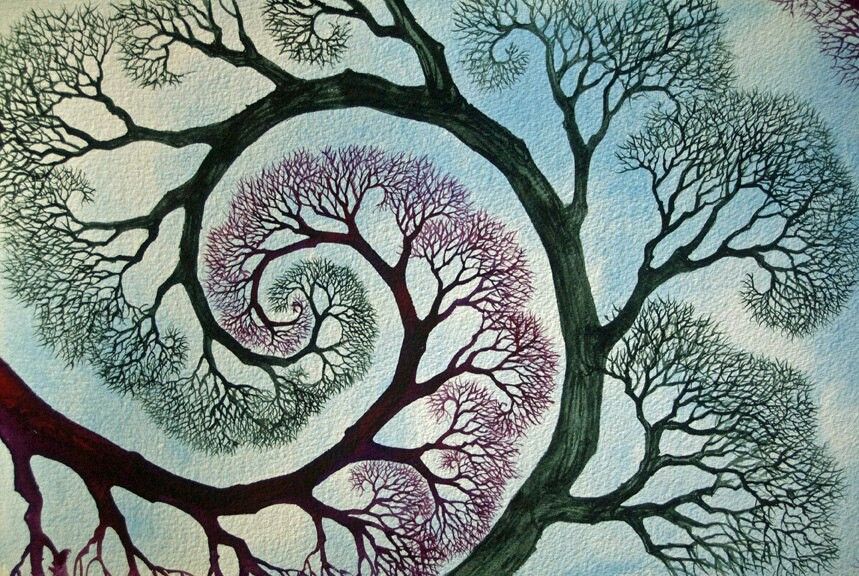
Consider a fractal like a tree branch: each smaller branch resembles the entire tree structure. It will grow depending on how it is constituted through its DNA (Brand Essence). Its growth depends on both the DNA and the kind of nourishment and environment it has access to (Brand Story). And finally, it takes space in interaction with other trees and pollinators to bear fruit (Brand Space).
1. Brand Essence: receiving wholeness
First, a brand has a unique essence that distinguishes it from others. Every tree branches differently. It’s the DNA, the constitutional element that distinguishes it from others and influences how it grows. The Brand Essence is reflected by the dominant energies you incorporate and the archetypes your brand embodies.
- What energies are most present? Is there emotional receptivity? Wise action? Grounded presence? Creative openness?
- What archetypes does the brand embody? How attuned are they to their environment? How do they relate to others in the field?
At re:storied, we held space for our own truths to emerge. Our team’s energy is rather airy – creative and spatious. That’s why we bring grounding through shared rituals, interseasons, and physical gatherings (Emilie’s article: Crafting an energetic and regenerative business). We hold space for empathically listening to clients’ unique energies and archetypes before starting outer branding work. We’re also in the process of developing the “Archetypes of Regeneration” deck.
2. Brand Story: embodying regeneration
Second, fractals have a specifically shaped body. A structure and form that can hold other branches and fruit. It follows the script of its own essence, attunes to its environment, and provides stability and orientation. This is the Brand Story that structures how the brand holds meaning: its memory, its action, its vision. It will look different depending on the kind of client. The story is at a constant interplay of essence and space, through embodied learning shared through storytelling.
- Regenerative Storytelling: beyond the lonely hero, we design stories that present the client’s work as a living organism. It is connected to place (soil), to memory (roots), to communities (species), and to a dream (fruit), among others.
- Somatic practices: within our branding process, we hold space for exploring how our clients’ stories sit in their own bodies. This is the filter we use to ensure their story feels aligned. It is a precondition for powerful, resonant stories that touch something deep in others.
At re:storied, we realized that to practice being a regenerative agency, we needed to cultivate the soil. We took 1.5 years to mature the knowledge and wisdom we held. As part of the Regenerative Communications Collective, we held conversations on what makes storytelling regenerative.
We learned that we are not just creators of stories, but often receivers. And if we are in connection with nature, then our stories would also reflect the very organizing principles of nature: self-organizing, mutually attuned, and diverse, among others.
3. Brand Space: pollinating ecosystems
Third, brands have a specific presence in space. The branches spread where there is space and light. They hold fruits that interact with pollinators. This is the Brand Ecosystem – a Client Pollination System – able to attract clients and stakeholders, and reciprocate value by giving back. It is influenced by who else is there and how work can spread. More than just mere brand positioning, it understands brand success by the quality and dynamics of its interactions.
- Client Pollination System: Rather than a mechanistic marketing funnel, we base our work to attract business opportunities for our clients on pollination principles. This involves mapping the field (audiences), understanding the species that populate it (archetypes), and how they interact (touchpoints).
- Narrative strategy: based on the client’s story, we explore the fields of potential that, by definition, are invisible. This is the “negative space” of regenerative work. Tending to what is not yet manifested, but most crucial. That’s the direction our narrative efforts focus on.
At re:storied, we see products and services as an extension of the essence and story of our clients – playing the role the ecosystem needs. The marketing system – pollination system – is giving a taste of that role – an experiential, embodied, aesthetic taste of what will come next when working with them. This is why, with our own brand, we lead with storytelling, aesthetic resonance, and a Communications Pulse check to “taste our work”.
Conclusions
Regenerative brands embody the kind of world they want to create. They become an touchpoint for others to experience that world. In today’s accelerating and noisy world, to differentiate from business-as-usual, we believe that what sets a brand apart is its essence, story, and the space it can nurture.
Curious?
- Join “Worlding your brand” on 12 May: a live workshop to explore what makes your brands more resonant, more coherent, and more alive than others
- Take the Communications Pulse Check: a ca. 30 min audit for you to understand how aligned, transformative, and relevant your communications currently are.
Come explore with us
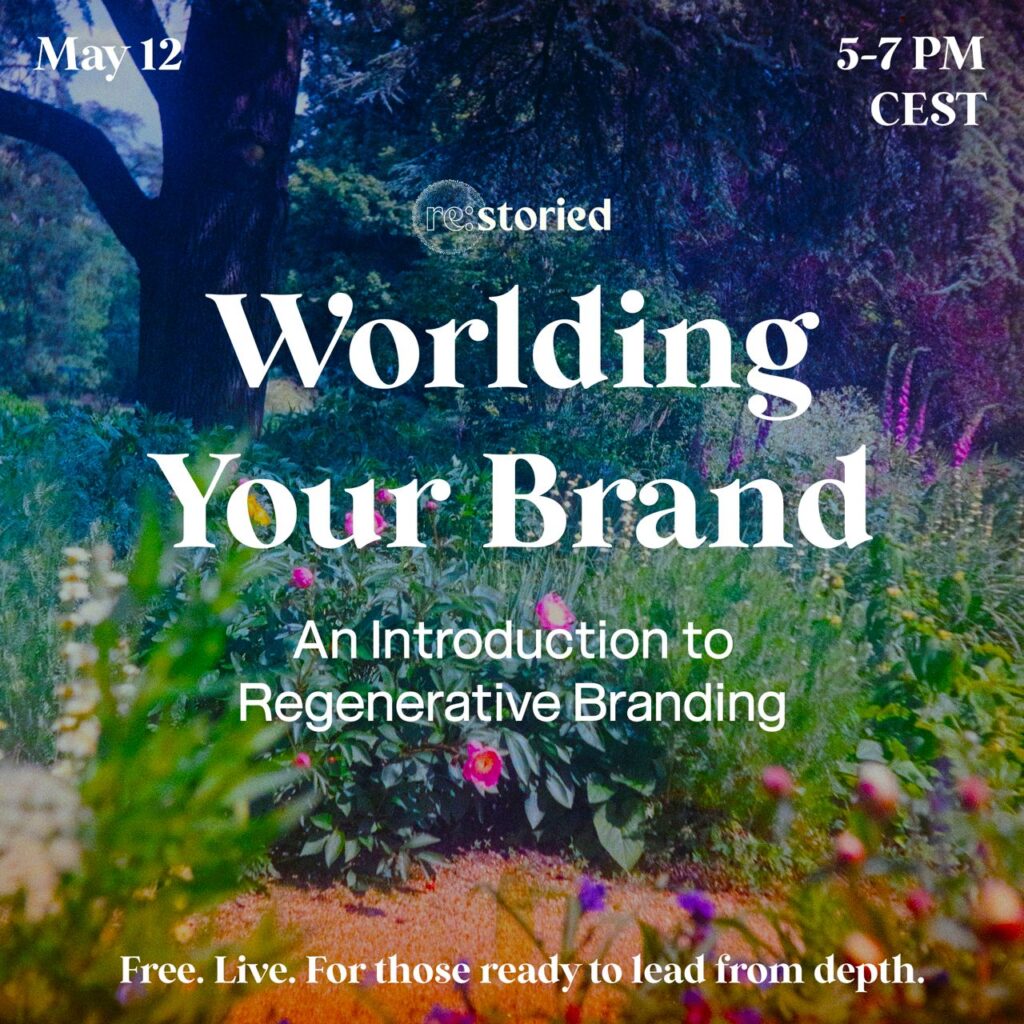
We’re hosting a live session to share what we’ve learned guiding regenerative pioneers through brand transformation.
Worlding Your Brand: An Introduction to Regenerative Branding
🗓️ Tuesday, May 12 – 17:00h CEST
This isn’t a masterclass in persuasion, with hacks and hooks. It’s an exploration of what happens when you stop broadcasting about regeneration and start communicating from it. When your brand becomes a living story that holds a vital conversation alive. When you compost expired identities and let your essence lead.
We’ll share our framework, walk through a real transformation (the Minds & Mountains case), and guide you through a self-diagnostic to map your own brand’s vitality.
Cover photo © Melanie Hughes